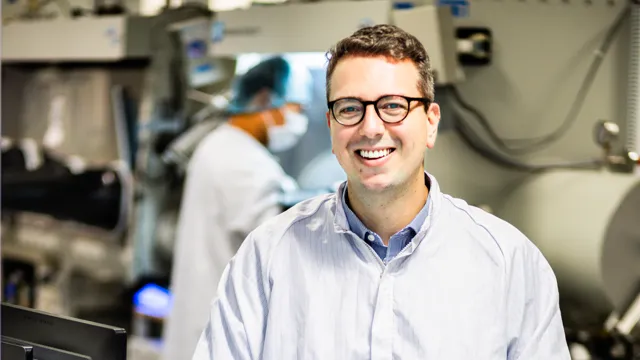
“The multi-functionality of these materials is as important as their predicted hardness, which may lead to their application in fields where diamond doesn’t offer desired combinations of properties�, says Florian Trybel, assistant professor at Linköping University, part of the discovery team and co-author to the article. “At the moment, the synthesis pressures and temperatures of these materials are too high to produce large quantities efficiently. Theoretical simulations will play an important role in predicting new synthesis pathways at less extreme pressure and temperature conditions. This will enable us to further investigate their outstanding properties and move towards industrially relevant scales.�, he adds.
The researchers stress that the international collaboration — led by experimentalists from the University of Edinburgh and the University of Bayreuth, as well as theorists from the Theoretical physics division at Linköping University — with diverse backgrounds and scientific fields was the key to a successful discovery. The article resulting from this discovery has been a success in its own right, receiving much attention, see .
Article: ; Dominique Laniel, Florian Trybel, Andrey Aslandukov, Saiana Khandarkhaeva, Timofey Fedotenko, Yuqing Yin, Nobuyoshi Miyajima, Ferenc Tasnádi, Alena V. Ponomareva, Nityasagar Jena, Fariia Iasmin Akbar, Bjoern Winkler, Adrien Néri, Stella Chariton, Vitali Prakapenka, Victor Milman, Wolfgang Schnick, Alexander N. Rudenko, Mikhail I. Katsnelson, Igor A. Abrikosov, Leonid Dubrovinsky, Natalia Dubrovinskaia; Advanced Materials, DOI: 10.1002/adma.202308030.
Written about this in other media:
- )