ҳ

26 March 2026

LiU professor Anders Ynnerman is one of ten Swedes to have had an asteroid named after them. His visualisation research takes us out into space through the software OpenSpace, which opens up the entire known universe to the public.

A man standing in front of a planet. Photographer: Thor Balkhed
Anders Ynnerman, professor of scientific visualisation at LiU, has an asteroid in the belt between Mars and Jupiter named after him.

Anders Ynnerman is professor of scientific visualisation, director of Visualization Center C in Norrköping and one of the pioneers of visualisation research. He leads OpenSpace, an international research project whose software brings together information on planetary orbits and space weather, satellite imagery, data from robotic missions to other planets and much more.

Into space in the dome theatre
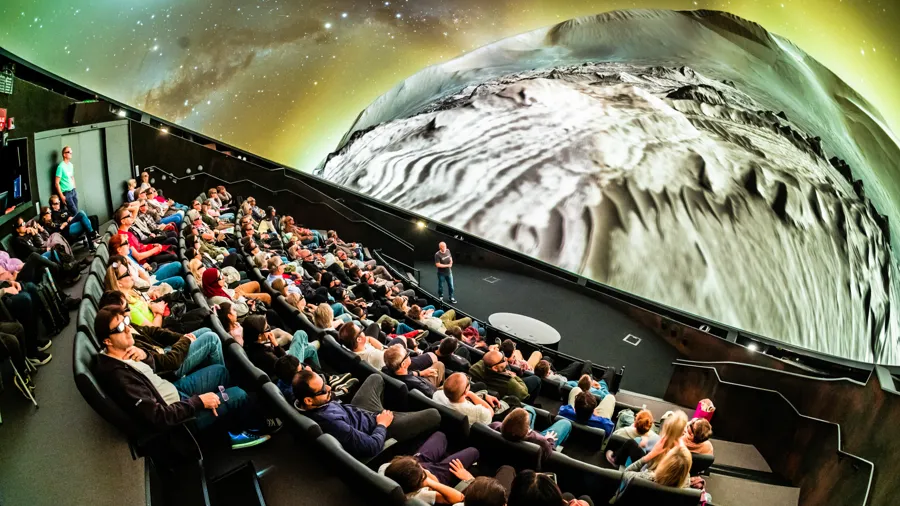
A group of people sitting in front of a projection screen. Thor Balkhed
The dome theatre at Visualization Center C.
The OpenSpace software enables journeys into space in Sweden’s five major dome theatres. In addition to Norrköping, these are located at science centres in Gothenburg, Stockholm, Malmö and Umeå. Experiences range from live visualisations to full-dome films that completely surround the audience. It forms part of the national initiative Wisdome, which Anders Ynnerman also founded. The aim of Wisdome is to increase interest in science and technology among children and young people.

Anders Ynnerman feels deeply honoured and proud to have an asteroid named after him.

“Tremendous fun! Space has been an interest since childhood. I watched the Moon landing when I was six years old and I was fascinated,” he says.

Why do you think the asteroid was named after you?

“In my role as professor, my lifelong interest in astronomy and space has been part of building up Visualization Center C and the research at Campus Norrköping. I suppose that my role as an ambassador for space, and my interest in communicating with the public and new generations, are the reasons I’ve now had a celestial body named after me – Ynnerman 15313.”

The asteroids named after Swedes who have made contributions in space-related fields were discovered in the early 1990s. They form part of the asteroid belt between Mars and Jupiter, which consists of millions of these small celestial bodies.

Newly discovered asteroids are initially given provisional designations and may later be given official names once their orbits around the Sun have been determined. In February this year, the International Astronomical Union announced that several objects had been given new names.

Honorary doctors among those with asteroids named after them

Among the ten Swedes with asteroids named after them are two honorary doctors of Linköping University. One of them is astronaut Marcus Wandt, who became the third Swede in space when he travelled to the International Space Station (ISS). The other is the astronomer Marie Rådbo, professor emerita at the University of Gothenburg and well known for her public engagement in astronomy.

A man (Marcus Wandt) standing in a lecture hall. Thor Balkhed
Astronaut Marcus Wandt, honorary doctor at LiU, has also given his name to an asteroid. Here he is giving a lecture at Campus Valla in Linköping.

Translation: Simon Phillips

Anders Ynnerman explains more about:

… the development of space visualisations and OpenSpace:

“As early as 2001, in collaboration with Carter Emmart at the Hayden Planetarium in New York, we began developing interactive visualisations for large display systems such as planetariums. Now we have the OpenSpace software, which is widely used all over the world and allows us to make remarkable interactive journeys into space. I’ve had the privilege of being one of the founders and leaders of the project, with the American Museum of National History in New York as the main partner. NASA, New York University and the University of Utah are also involved. Over the years, up to a hundred students from LiU have completed degree projects within our space projects, often on site with our partners in the United States, including NASA. Together with Alexander Bock, assistant professor at LiU and project manager for OpenSpace, I often show well-received visualisations in the dome and I’ve produced films about space.”

… the Wisdome initiative:

“Wisdome is an initiative funded by the Knut and Alice Wallenberg Foundation, which began with an anniversary donation. It’s a collaboration between five leading science centres in Sweden – Visualization Center C in Norrköping, Universeum in Gothenburg, the National Museum of Science and Technology in Stockholm, Malmö Museum and Curiosum in Umeå. We reach millions of visitors every year.”

Contact

Latest news from LiU

Woman at office.

Biogenic carbon dioxide could become a key resource as biogas expands

During the production and upgrading of biogas, carbon dioxide is released, a greenhouse gas that affects the climate. However, research at ҳ shows that this carbon dioxide has several uses and could become an important resource.

A man wearing glasses standing in front of a red wall.

Moral economy perspectives through history

When a crisis arises, a humanitarian urge to help others is often awakened. But what happens when emotions rule and knowledge is lacking? Norbert Götz, professor of modern history, has researched the conditions of humanitarian aid.

A couple of men standing next to each other in front of a blackboard.

Scientists mimic heart muscle cells with conductive plastic

For the first time, scientists have succeeded in artificially mimicking the ion signalling of heart muscle cells. To succeed, researchers at LiU have used organic electronics. The findings open up for new types of implants and sensors.