
Why are you pursuing a PhD?
My passion for computer vision began in 2017 during my bachelor’s studies. I took Andrew Ng’s MOOC on Coursera and was immediately captivated by the potential of using pixel data to navigate a car. Later, a brief stint in the industry made me realize that my true calling lies in fundamental research rather than purely industrial development.
What is the best part about doing a PhD?
Definitely the freedom to explore research ideas and conduct experiments. My work is driven by pure curiosity and a desire to solve complex problems. That excitement is what keeps me motivated—and occasionally staying up late in the lab!
What is the most challenging part of doing a PhD?
The most difficult part is defining a research question that is truly significant. A well-defined problem often dictates the trajectory of your research and determines the ease of the peer-review process for conferences and journals.
Do you have any tips for new PhD students?
Select courses strategically to bridge the gap between your background and your research area, and try to finish most credits in your first two years. Once you’re settled, start experimenting early while constantly reflecting on the underlying theory. Research is an iterative process of verifying hypotheses and refining theoretical models.
If you are a student and want to pursue a PhD, how should you go about it?
Start identifying your interests early in your master’s program—pay attention to the courses you genuinely enjoy. Project-based courses are invaluable for gaining hands-on experience. Finally, try to conduct your master’s thesis within a research group or work as a Teaching Assistant (TA) to build connections with researchers in the field.
Why are you doing your PhD specifically at LiU?
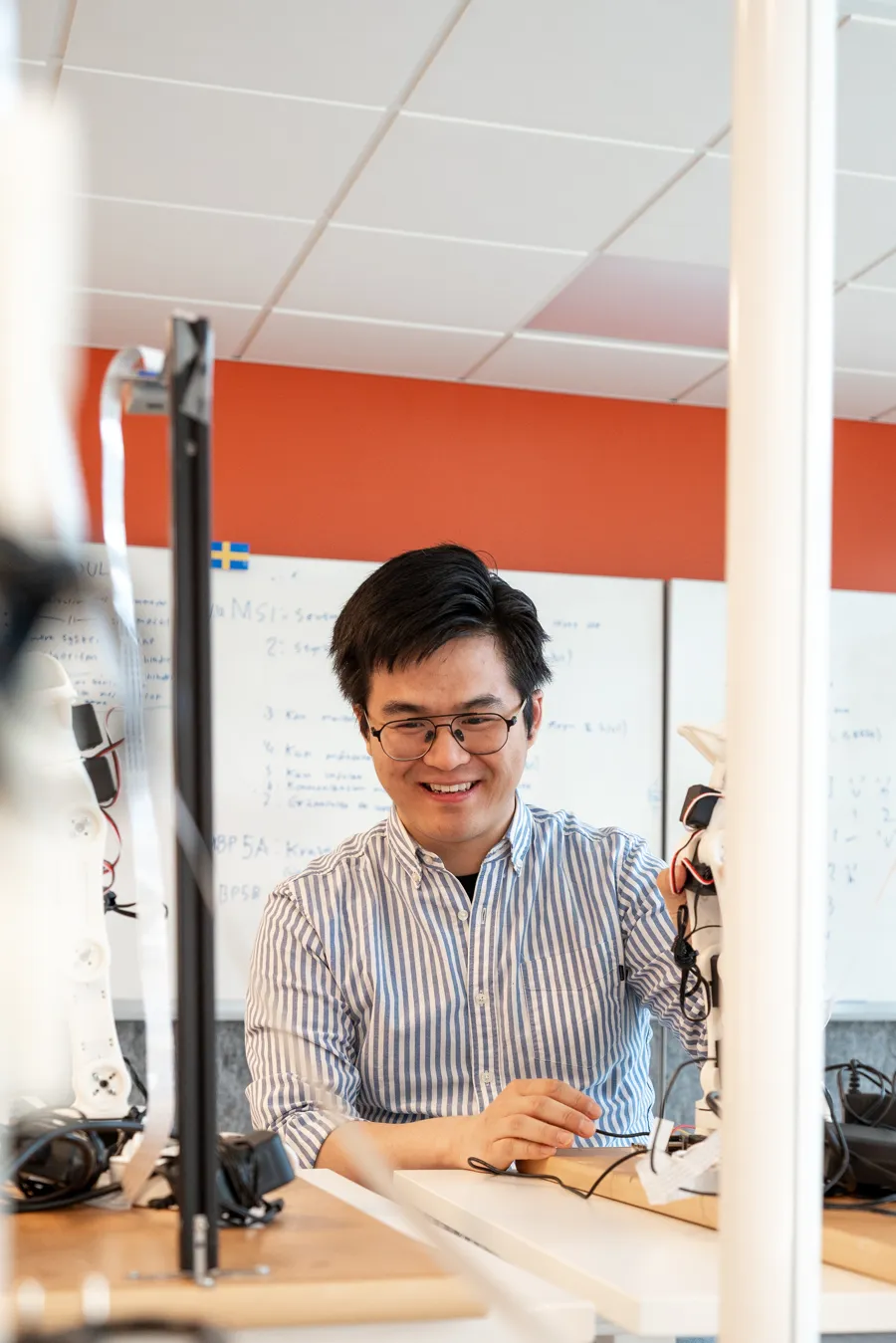 Simon Höckerbo
What is it like to be a PhD student at ISY?
It’s a fantastic experience. I work closely with my two supervisors and enjoy a high degree of flexibility to explore topics I’m passionate about. During my first two years, I focused on completing course credits; as a WASP Graduate School student, I had the opportunity to travel to other Swedish universities, which provided excellent networking opportunities. I also dedicate about 20% of my time to teaching and supervising master’s theses. Outside of work, I co-organize a weekly sports session for ISY, which has been a great way to make friends.
What is your research project about?
My research project, “Situation-Aware Perception for Safe Autonomous Robotic Systems,” focuses on adapting perception algorithms to handle scenarios with significant uncertainty, ultimately enhancing the safety and reliability of autonomous systems.
What will you do after completing your PhD?
I view a PhD as the first milestone in a research career. I plan to pursue a postdoctoral position. I hope to continue my work in autonomous driving safety, applying my insights on uncertainty to emerging fields like Vision-Language Models (VLMs) and World Models.


