ÌÇĐÄÍűÒł°æ

17 March 2026

The open-source mapping software QGIS has released a new major version; Desktop 4.0 Norrköping. It was launched in March 2026 after the international QGIS community gathered in the city last year.

Norrköping city center from the air. Photographer: Thor Balkhed
Norrköping—a physical city, a digital twin, and now also a map software.
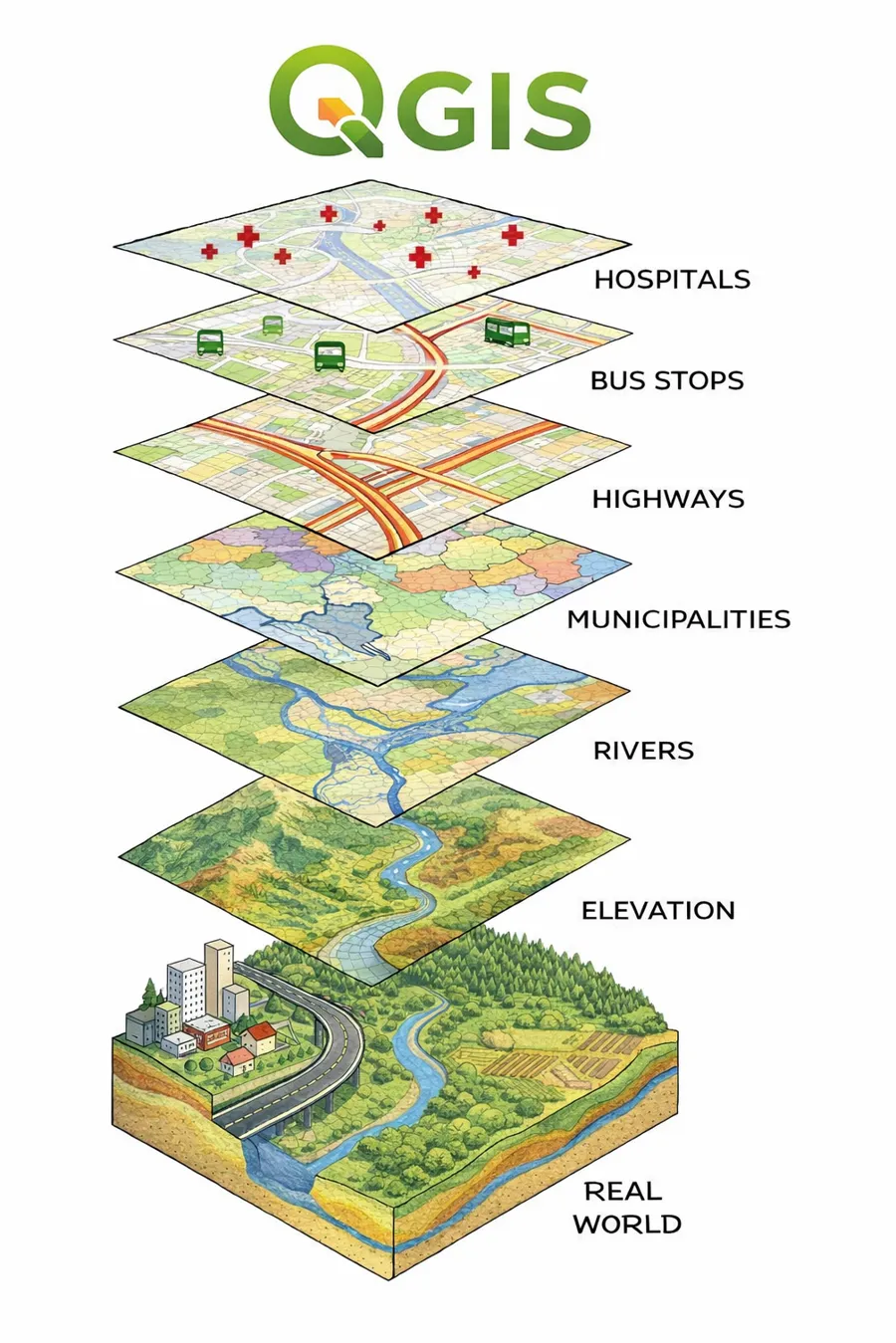
Visualisering av datalager i QGIS ovanpÄ en tecknad landyta Copilot AI
QGIS can display various facts about a surface on Earth.
QGIS is a geographic information system used for working with maps and spatial data. The software is worldwide to collect, analyze, process, and visualize information linked to locations on Earth. With QGIS, users can combine different map layers—such as satellite imagery, property boundaries, roads, and elevation data—to analyze everything from urban planning and environmental changes to traffic flows or flood risks.
The program is free and based on open-source code, and is used professionally by government agencies, researchers, companies, and journalists. QGIS is opened globally around 20 million times each month, and the number of users has steadily increased in recent years.
In June 2025, the international QGIS User Conference was held in Norrköping, where around 300 participants from 37 countries gathered for presentations, workshops, and discussions about the future of GIS technology. A tradition is that the host city of such a developer meeting lends its name to an upcoming version
Stort bord med 3D-modell av Norrköping.
Visual City. Visitors control which “layer” they want to view.

— and that version was released in March 2026.
At Linköping University, GIS and geodata are used in several research fields. Researchers such as Andreas Kerren, Kostiantyn Kucher, and Katerina Vrotsou work on methods for analyzing and visualizing complex data, where map information often plays a central role.
Researcher Erik TelldĂ©n has also worked on projects where geodata is linked to digital urban environments. One such project is Norrköping’s digital twin Visual City, a three-dimensional model where urban data can be projected and analyzed. This type of visualization often relies on geodata that is first processed in GIS tools like QGIS.
The fact that the new version of the software bears the name Norrköping connects LiU’s research in visualization and geodata with one of the world’s most widely used open tools for map analysis.
QGIS 4.0 Norrköping primarily represents a technical modernization of the software and is built on an updated graphics component platform. This provides better performance and makes it easier to develop new features in the future. This version also includes several improvements related to the handling of so-called point clouds.
A schematic illustration of how QGIS can display various facts about a surface on Earth.

Visual City at Visualization Center.
“Visual City” at the Visualization Center in Norrköping, where large amounts of data about the city are visualized using ceiling projectors onto a physical model of the city—for example, what areas would flood at different water levels, how the sun moves on different days of the year, or how noise varies across days. Photo: Thor Balkhed

Latest news from LiU

A couple of people sitting at a desk in front of a computer.

How childhood liver tumor cells acquire different features

Researchers have discovered how the so called Wnt signaling pathway can result in tumor cells with different features within a single tumor. Their findings contribute to better classification of these tumors.

En nÀrbild av en man som bÀr glasögon.

David Engblom wins award for his research on how our brains make us feel ill

David Engblom, Professor of Neurobiology, is awarded the 2026 Onkel Adam Prize for outstanding research at the Faculty of Medicine. He researches the role of the brain in making us feel ill in various medical conditions.

Woman at office.

Biogenic carbon dioxide could become a key resource as biogas expands

During the production and upgrading of biogas, carbon dioxide is released, a greenhouse gas that affects the climate. However, research at ÌÇĐÄÍűÒł°æ shows that this carbon dioxide has several uses and could become an important resource.